Hollow glass microsphere is a kind of ultra-lightweight inorganic non-metallic material with hollow structure, and it is a versatile and high-performance new lightweight material developed in recent years. It will be the new composite materials at twenty-first century.
Hollow glass microspheres are widely used in composite materials such as FRP, man made marble and man made agate. They can decrease the weight of the composite materials and the composite materials have excellent performance of sound insulation and heat preservation, and they can improve the mechanical performance of the composite materials such as strengthened rigidity, enhanced anti-impact property, excellent anti-breaking property and re-processing function. Hollow glass microspheres are applied in a wide range of fields such as aviation, space flight, new bullet train, luxurious yacht, adiabatic dope, bowing balls, in which they play a distinctive role. Hollow glass microspheres are the excellent sensitized of emulsion explosive. They can improve the detonation property of emulsion explosive and prolong the shelf period of emulsion explosive. When used in the resin putty, hollow glass microspheres can increase the volume of resin putty, improve its polishing function. Packing: net 10kgs in Plastic film lined plastic weaving bags or strong cartons.
High-performance glass bubble & hollow glass microsphere T20 is a kind of ultra-lightweight inorganic non-metallic material with hollow structure, and it is a versatile and high-performance new lightweight material developed in recent years. It will be the new composite materials at twenty-first century. Its true density is 0.15-0.60g/cm3 with 2-120m in diameter. It owns features with light weight, large bulky, low thermal conductivity, high compressive strength, smoothly mobility etc.

From:frbiz.com
These hollow glass microspheres offer a variety of advantages over conventional irregularly-shaped mineral fillers or glass fiber.
Improving fuel economy and the environment with Glass Microspheres.

From:3M
Hollow glass microsphere have been used for almost 30 years in many fields. They have the advantage of being light and cheap. They can be used in a variety of products, including sports equipment, insulation, automobile bodies, marine craft bodies, paints, and fire and heat protection devices.
The sample-list below shows the types of products that would be enhanced with Hollow glass microsphere.
PLASTICS: BMC, SMC, Injection Molding, Extruding, PVC flooring, Film, Nylon, High Density Polyethylene, Low Density Polyethylene, Polypropylene
CERAMICS: Refractory, Tile, Firebricks, Aluminum Cement, Insulating Materials, Coatings
ROCK OIL: Oil well construction, Heat preservation of oil pies, Materials used again erosion
CHEMISTRY: Paints, Fillers, Dope
RUBBER: Tyre
SPORTS: Surf boards, bowling balls, Flotation Devices, Golf equipment
MILITARY: Explosives, Screen shielding, Soundproof
SPACE: Aerospace coatings, Aerospace composites
SAILING: Ship bodies, Floating materials, Navigation marks
AUTOMOTIVE: Composites, Undercoating, Engine parts, Brake pads, Trim molding, Body fillers, Plastics, Sound proofing materials
CONSTRUCTION: Specialty cements, Mortars, Grouts, Stucco, Roofing materials, Acoustical panels.
Nickel Coating Technology – Nickel is a metal which lends itself to the electroless plating methods employed by MTL for particle coating. It has the potential to be used in a number of application areas, not least as a cheaper alternative to conductive silver.
However, in this particular application, nickel demonstrates gradual surface ‘passivation’ and the level of conductivity decays over a relatively short time. This may be an issue which could be resolved through further development work.
Nickel coated hollow glass microspheres also have ferromagnetic properties, which MTL has investigated with respect to their use in low density materials for radar absorption. Unfortunately, the frequency bands of interest in ‘stealth’ applications are not strongly absorbed by the nickel composites prepared using MTL materials. This application may be better served by the iron coating technology developed by MTL .
There could be potential in the use of light weight cores coated with relatively thick nickel layers e.g. up to 10 microns. These materials could be used in inductive heating applications where the relatively low thermal mass of the coated low density core would be of advantage in rapid temperature cycling. Opportunities still exist in this area and MTL have established methods for the preparation of coated particles of the necessary specification.
From:microspheretechnology
These hollow glass microspheres offer a variety of advantages over conventional irregularly-shaped mineral fillers or glass fiber.
Can improve fuel economy.
From:3M
Researchers from Carnegie Melon University and Karlsruhe Institute of Technology have recently published an article in Journal of the Royal Societytitled Staying Sticky: Contact Self-Cleaning of Gecko-Inspired Adhesives that presents the first gecko-inspired adhesive that matches both the attachment and self-cleaning properties of gecko’s foot on a smooth surface.
Using glass microspheres to simulate contamination the scientists created a synthetic gecko adhesive that could self-clean and recover lost adhesion. Real world applications of self-cleaning adhesives are reusable adhesive tapes, clothing, medical adhesives (bandages) and pick-and-place robots, among others.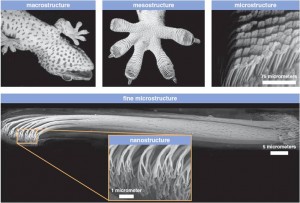
Everyday challenge with traditional adhesives is that they loose their stickiness once contaminated. Geckos have been intriguing researchers for decades because of their unique and striking capability to maintain the stickiness of their toes through contact self-cleaning. They can travel up the walls and ceilings in a wide variety of “dirty” settings retaining adhesion.
Upon experimentation, scientists discovered that the critical variable is the relative size of microfibers that make up the adhesive compared to the diameter of contaminant particles. Glass microspheres were used in diameters from 3 to 215microns. Glass microspheres were packed in air and used as supplied. Contamination of the samples was achieved by brining each sample in contact with a monolayer of glass microspheres with specific speeds under predetermined compressive loads. The cleaning process involved a load-drag-unload procedure.
Best self-cleaning results were obtained with the largest contaminants (glass microspheres), with the size of the adhesive fiber much smaller than the contaminating particle. This information is important to know when designing self-cleaning adhesives—make the adhesive fibers much smaller for improved adhesion recovery. This cleaning mechanism requires unloading particles by dragging. The other extreme of contaminating microspheres being much smaller than the adhesive fibers has advantages in some situations, even though it works by a different mechanism. Smaller microspheres tended to become embedded into the adhesive material. Particle embedding is a temporary cleaning process but might be sufficient in some applications.
FROM:microspheres.us
Optical glass beads, as a new product in the glass industry. It has a certain chemical stability, mechanical strength, electrical insulation and be rounded, uniform, and good liquidity.Its most unique properties with the original glass transparency, with the return of retroreflective performance. Especially the use of different conventional glass raw material of high refractive index glass beads much broader range of applications than the ordinary type beads, in addition to serving highways and airports and all kinds of road marking paint sign board outside,Can also be made reflective clothing, reflective rain gear, a traffic policeman on duty at night with reflective sleeves, etc. It can greatly reduce traffic accidents at night or in rain and fog days. Early in the 1960s the US government to develop a “federal highway regulations” provides highway lane, traffic signs, road signs, road signs and so on.In the headlights illuminated necessary to achieve the standard luminous indicators improve visibility distance traffic signs, the need to adapt to the highway. That this is to reduce traffic accidents most cost-effective way.”International maritime rescue organization” has also been stipulated that all vessels with a life buoy, life jackets and all life-saving equipment and the corresponding buoy flags are required glyphs reflective material with a high refractive index glass beads made.Helicopters and lifeboats to sea only available light to detect targets at night and rain and fog days in the rescue time and space. So that in addition, the use of high refractive index glass microspheres made of other reflective materials are also widely used in other industries, for example: large oil derrick, tower, movie screen, large public spaces such as billboards.
Summary:
K20 glass bubbles have a density of 0.2 g/cc and an isostatic crush strength of 500 psi.
Properties:
Lower viscosity, improved flow
Increased filler loading, reduced cost
VOC reduction
Chemical stability and inertness
Reduced dielectric constant
Thermal conductivity reduction
Temperature resistance
Applications:
Mining
Paints and coatings
Insulation and buoyancy
Transportation
from: palmerholland
