 Glass Bubbles are engineered hollow glass spheres that
can be used as a density reducing additive.
Used for drilling fluids/cement slurries to reduce
and control bottom hole pressure.
This article comes from 3M Edit Post
Hollow glass microsphere, glass bubble, glass microsphere, floater, Floating Beads, pearl drift
Glass Bubbles are engineered hollow glass spheres that
can be used as a density reducing additive.
Used for drilling fluids/cement slurries to reduce
and control bottom hole pressure.
This article comes from 3M Edit Post
Thermal conductivity measurements were performed to determine the characteristics of hollow glass microspheres as an insulating material and as an opacifying agent for other insulations. The experiments were carried out with a radial flow heat transfer apparatus especially designed to suppress extraneous heat transfers, both internal and external to the heated section, and to provide uniform temperatures on the bounding surfaces. Three types of microsphere insulations were investigated, differing in bulk density and in the presence or absence of an aluminizing coating. The thermal conductivity of the microsphere insulations was found to be about one and a half times that of stagnant air over a wide temperature range. Additional experiments, involving the use of an opacifier (powdered silicon), demonstrated that radiative transfer has a minor effect on the thermal conductivity of microsphere insulations. This finding was corroborated by the fact that the high-temperature conductivity of the aluminized microspheres was not appreciably different from that of the uncoated microspheres. Another set of experiments was performed in which microsphere insulation was added to opacify silica aerogel, a fine powder insulation that is markedly affected by radiative transfer. The presence of the microspheres brought about reductions in conductivity of almost a factor of two at an optimum mixture ratio of the constituents. Furthermore, it was found that the conductivity of such a mixture was lower than that of either constituent, thereby illustrating their synergistic interaction.
Copyright © 1976 by ASME
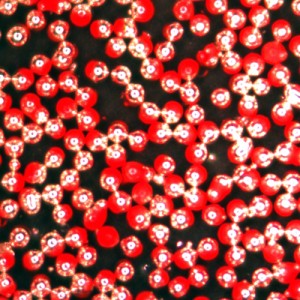
They offers unique capability to manufacture microspheres and micro-particles with partial coatings and dual functionality. Currently half-shell or hemispherical coatings can be applied to any sphere (glass, polymer, ceramic) in sizes 45 micron in diameter on up to 1mm and higher. Hemispherical coatings of less than 1 micron with tolerances as low as 0.25 micron have been routinely demonstrated. Color combinations are truly unlimited. White, black, silver, blue, green, red, yellow, brown, purple in both fluorescent and non-fluorescent have been made. Sphericity of greater than 90% and custom particle size ranges are offered.
The custom coating capability offers customers the ability to create fluorescent glass micro-spheres of the specific size and emission/excitation needed. As the micro spheres and coating are solvent resistant they work ideally as fluorescent tracers or highly visible targets. We can overcoat clear glass or silver coated glass for the effect needed.
For those needing very large Spheres can coat spheres of 1 mm and larger.
The microparticles are now available as either dry powder or in a dielectric oil.
From:Microspheres Online
Glass microspheres are microscopic spheres of glass manufactured for a wide variety of uses in research,medicine, consumer goods and various industries. Glass microspheres are usually between 1 to 1000 micrometers in diameter, although the sizes can range from 100 nanometers to 5 millimeters in diameter. Hollow glass microspheres, sometimes termed microballoons, or glass bubbles have diameters ranging from 10 to 300 micrometers.
Hollow spheres are used as a lightweight filler in composite materials such as syntactic foam and lightweight concrete. Microballoons give syntactic foam its light weight, low thermal conductivity, and a resistance to compressive stress that far exceeds that of other foams. These properties are exploited in the hulls of submersibles and deep-sea oil drilling equipment, where other types of foam would implode. Hollow spheres of other materials create syntactic foams with different properties, for example ceramic balloons can make a light syntactic aluminium foam.
Hollow spheres also have uses ranging from storage and slow release of pharmaceuticals and radioactive tracers to research in controlled storage and release of hydrogen. Microspheres are also used in composites to fill polymer resins for specific characteristics such as weight, sandability and sealing surfaces. When making surfboards for example, shapers seal the EPS foam blanks with epoxy and microballoons to create an impermeable and easily sanded surface upon which fiberglass laminates are applied.
Glass microspheres can be made by heating tiny droplets of dissolved water glass in a process known as ultrasonic spray pyrolysis (USP), and properties can be improved somewhat by using a chemical treatment to remove some of the sodium. Sodium depletion has also allowed hollow glass microspheres to be used in chemically sensitive resin systems, such as long pot life epoxies or non-blown polyurethane composites
Additional functionalities, such as silane coatings, are commonly added to the surface of hollow glass microspheres to increase the matrix/microspheres interfacial strength (the common failure point when stressed in a tensile manner).
Microspheres made of high quality optical glass, can be produced for research on the field of optical resonators or cavities.
Glass microspheres are also produced as waste product in coal-fired power stations. In this case the product would be generally termed “cenosphere” and carry an aluminosilicate chemistry (as opposed to the sodium silica chemistry of engineered spheres). Small amounts of silica in the coal are melted and as they rise up the chimney stack, expand and form small hollow spheres. These spheres are collected together with the ash, which is pumped in a water mixture to the resident ash dam. Some of the particles do not become hollow and sink in the ash dams, while the hollow ones float on the surface of the dams. They become a nuisance, especially when they dry, as they become airborne and blow over into surrounding areas.
Sinosteel Maanshan Institute of Mining Research Co., Ltd., established in 1963 and directly subordinate to the former Ministry of Metallurgical Industry, is a large comprehensive research and development institution in China’s metallurgical mine field. We are one of the units approved early by the Academic Degree Awarding Committee of the State Council to have independent right to award the master academic degree and one of the units approved by the State Economic and Foreign Trade Ministry to have the right to import and export products. Our firm developed into a scientific and technological enterprise in 1999 and now belongs to China Sinosteel Group.
Sinosteel Maanshan Institute of Mining Research Co., Ltd. is a National Torch Program High-tech Enterprise. Our firm has outstandingly completed a series of major national scientific and technological projects, including “the Sixth Five-Year Plan” and “the Eleventh Five-Year Plan”, and published over 2,500 academic papers at home and abroad. Our firm has more than 1,700 sets of all kinds of equipment and facilities and over 50 supporting pilot plants. Sinosteel Maanshan Institute of Mining Research Co., Ltd. cooperates with Chinese Academy of Sciences to develop an industrialized technique to produce high-performance hollow glass microspheres, filling a gap at home.
Sinosteel Maanshan Institute of Mining Research Co., Ltd. is located in Maanshan — known as the National Civilized City, the National Sanitary City and the National Garden City. Maanshan is described as “a Branch of Flower along the Yangtze River”. The hollow glass microsphere company (subsidiary of Sinosteel Maanshan Institute of Mining Research Co., Ltd.,) covers an area of 20,000m2, with several large-scale standard plants totally up to 10,000m2 and integrated modern office buildings of 7,000m2. Our company has obtained ISO9001:2000 quality management system certificate. In the fierce market competition, our company holds the business spirit of “quality, honesty, good service” and relies on advanced technology and strong strength to provide customers with better products and services.
Summary:
K37 glass bubbles have a density of 0.37 g/cc and an isostatic crush strength of 3000 psi.
Properties:
Lower viscosity, improved flow
Increased filler loading, reduced cost
VOC reduction
Chemical stability and inertness
Reduced dielectric constant
Thermal conductivity reduction
Temperature resistance
Applications:
Mining
Paints and coatings
Rubber and plastic
Compounding
Transportation
From:3M
Hollow glass microspheres (sometimes termed microballoons, or glass bubbles) have been used as low-density fillers for various kinds of polymeric compounds since the mid-1960s. They are gas-filled, spherical, borosilicate particles with diameters typically between 10 and 100 microns. The spheres are manufactured on an enormous scale by several companies worldwide and, despite their structure, they can have extremely high compressive strength. They are routinely used as fillers in concretes, syntactic foams and other structural components, particularly in the marine and aerospace sectors. The profile of weight saving materials has increased dramatically in recent years due to both rising oil prices and environmental awareness.
Someone has taken low density fillers to the next stage of development. By adding less than 100 nanometers of materials, such as metals and metal oxides to the surface of the hollow glass particles, hybrid materials can be generated which retain the functionality of the coating material itself, but with the benefits of significantly reduced density, better handling/recovery properties and improved particle/matrix interfacial strength. Using its expertise in particle coating, They has developed low density fillers coated with, amongst other materials, titanium dioxide and metallic silver. The aqueous-based processes used to make these materials readily lend themselves to large scale production.
The range of applications in which coated microspheres and microparticles can be used to enhance current composites, or provide new solutions, is extremely diverse and the size, density, surface chemistry and functionality required by end users tend to be application specific. There is significant scope, therefore, for the development of a wide range of new materials to meet these diverse market opportunities.
From: microspheretechnology
Hollow glass microspheres can be used as a continuous medium in low-density cement slurries. With addition of hollow glass microspheres, The slurry is incompressible and all wells are uniform in density. Used in drilling fluid, Sludge cakes formed have good lubrication, reducing the risk of sticking. Hollow glass microspheres have an irreplaceable advantage for it cannot affect the system signal. Hollow glass microspheres have a good rolling performance, and can increase the drilling rate, and significantly improve the drilling efficiency. Cementing with hollow glass microspheres has feature of high temperature resistance, high pressure resistance, stability, durability, and can be recycled. With the increase of pressure layer, low-density slurry cementing with hollow glass microspheres were adopted to consolidate the wells to prevent or reduce leakage, increase the cement top. It will improve single well production, and can be used effectively to obtain underground oil and gas and high temperature geothermal resources.
Hollow Glass Microspheres can be used in paint, rubber, plastics, FRP, artificial stone, putty and other products as filler and weight-reducing agent. It can also be the excellent sensitizer for emulsion explosives; Because of its high compressive properties, it can be used to produce high-strength low-density cement slurry and low density drilling fluid in oil and gas extraction industry.
S38HS glass bubbles have a density of 0.38 g/cc and an isostatic crush strength of 5500 psi. The S Series glass bubbles have smaller particle sizes than the K Series. The S38HS has a higher crush strength than the S38 glass bubble.
Properties
Low thermal conductivity
Virtually insoluble in water or oil
Increased Production Throughput
Lightweighting
Temperature Resistance
Chemical Resistance
Applications
Paints and coatings, Rubber and plastic, Compounding, Insulation and buoyancy, Transportation
From:3M
Glass microspheres are hollow spheres of glass manufactured for a wide variety of uses in consumer goods, medicine, research and numerous industries from Aerospace to Automotive. Hollow glass microspheres from Ceno Technologies, sometimes termed microballoons or glass bubbles, have diameters sized in micrometers (microns).
Glass microspheres from Ceno Technologies are free-flowing, high strength, low density, inert and have a wide variety of uses as a lightweight filler in composite materials, syntactic foams, paints, plastics, putties, mastics, fibreglass, sealants, varnishes, resins and cements.
Ceno Series HGT high performance microspheres are hollow, white in color and manufactured from soda-lime borosilicate glass in a range of sizes from 2 to 110 microns.
The soda-lime borosilicate composition and near perfect spherical shape of these hollow glass microspheres provide high compressive strength.
Hollow Glass Microspheres–Series HGT–Particle Sizes

Benefits include:

Other key properties include low water absorption, low heat conductivity, high chemical resistance and radio transparency.
Hollow Glass Microspheres – Series HGT – T

From:cenotechnologies
